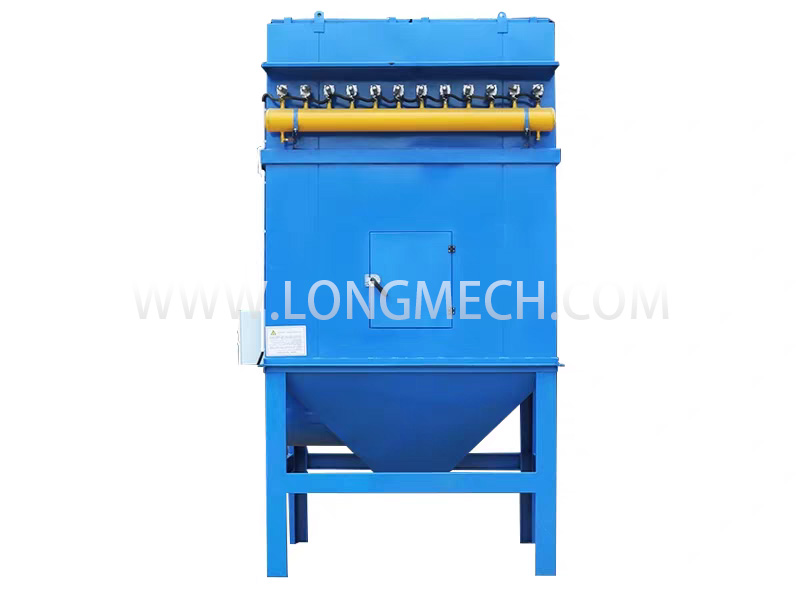
Pulse Jet Baghouse Dust Collector
Brand: Huawei
Listing time: April 2022
Bluetooth: Bluetooth 5.2
Screen: AMOLED color screen
Screen resolution: 466 * 466
Screen size: 1.43 inches
Battery capacity: 530mAh
Charging interface: wireless charging
Category:Pneumatic conveying equipment
Introduction
Pulse jet baghouse dust collector is an improved pulse jet bag filter based on conventional bag filters. As an air pollution control device, it is suitable for small and medium-sized dust conditions.
The equipment adopts high-strength filter bags with a dust removal efficiency ≥ 99%. It features bottom air inlet, off-line cleaning, off-line maintenance, external filtration, fully enclosed filtering zone, external maintenance and overhaul, and low emission concentration. Compared with electrostatic precipitators, pulse jet baghouse dust collectors have different characteristics in terms of floor space, required supporting equipment and long-term operating costs.
Working Principle
The pulse jet baghouse dust collector consists of a dust hopper, upper box, middle box and lower box, with the upper, middle and lower boxes adopting a compartmental structure.
During operation, dust-laden gas enters the dust hopper through the inlet duct. Coarse dust particles fall directly to the bottom of the hopper, while fine dust particles flow upward into the middle and lower boxes along with the airflow, accumulating on the outer surface of the filter bags. The filtered gas enters the upper box, flows to the clean air collecting duct and exhaust duct, and is discharged into the atmosphere through the exhaust fan.
The cleaning process is as follows: first, the clean air outlet duct of the compartment is cut off, so that the filter bags in this compartment are in a state of no airflow (compartmental air-stop cleaning). Then the pulse valve is opened to perform pulse jet cleaning with compressed air. The closing time of the shut-off valve is sufficient to ensure that the dust stripped from the filter bags settles into the dust hopper after jet cleaning, avoiding the re-adhesion of dust to adjacent filter bags with the airflow after leaving the filter surface, thus achieving thorough cleaning. The exhaust valves, pulse valves and ash discharge valves are fully automatically controlled by a programmable controller.
Equipment Features
- The pulse jet baghouse dust collector adopts compartmental air-stop pulse jet cleaning technology, which overcomes the shortcomings of conventional pulse dust collectors and compartmental reverse-bag dust collectors. It has strong cleaning capacity, high dust removal efficiency, low emission concentration, low air leakage rate, low energy consumption, low steel consumption, small floor space, stable and reliable operation, and good economic benefits. It is suitable for purification of dust-laden gas and material recovery in metallurgy, building materials, cement, machinery, chemical industry, electric power and light industry.
- Due to compartmental air-stop pulse jet cleaning, thorough cleaning can be achieved with one jet, thus extending the cleaning cycle, reducing cleaning energy consumption and greatly lowering compressed air consumption. Meanwhile, the fatigue of filter bags and pulse valves is reduced accordingly, doubling the service life of filter bags and valve plates.
- Maintenance and bag replacement can be carried out compartment by compartment without stopping the system fan and under normal system operation. The filter bag mouth adopts an elastic expansion ring with good sealing performance, firmness and reliability. The filter bag cage is polygonal, reducing friction between the bag and the cage, prolonging bag life and facilitating bag removal.
- Top bag extraction is adopted. When replacing bags, the cage is pulled out and the dirty bag is dropped into the dust hopper at the lower part of the box and taken out through the manhole, improving operating conditions for bag replacement.
- The box adopts an airtight design with good sealing performance. High-quality sealing materials are used for inspection doors, and kerosene leak detection is applied during manufacturing, resulting in a very low air leakage rate.
- The inlet and outlet ducts are compactly arranged with low airflow resistance.
Series Design
- According to different diameters of filter bags, different arrangements of filter bags per compartment and different filtering areas, pulse jet baghouse dust collectors are divided into three series, arranged in rows by compartment, including single-row and double-row arrangements:a. Single-row or double-row arrangement; pulse jet pressure can be low pressure (0.2–0.3 MPa) or high pressure (0.4–0.5 MPa) for user selection.b. Only double-row arrangement; pulse jet pressure is generally designed as low pressure (0.2–0.3 MPa).c. Only double-row arrangement; pulse jet pressure is high pressure (0.4–0.5 MPa). Special designs can be made per user requirements if needed.
- The dust concentration at the dust collector outlet is generally allowed to be below 30 mg/Nm³. Special designs are available for stricter user requirements.
- Pulse jet baghouse dust collectors are divided into online pulse dust collectors and off-line pulse baghouse dust collectors. Online pulse baghouse dust collectors are more suitable for dust with high specific gravity and dryness. Off-line pulse baghouse dust collectors are suitable for dust with low specific gravity, slight viscosity and humidity.
- The cleaning principle of online pulse baghouse dust collectors is that single-row or double-row compressed air reversely blows the filter bags under negative pressure. Off-line pulse baghouse dust collectors reversely blow the filter bags with compressed air without air pressure influence.
Pulse jet baghouse dust collectors come in various specifications, with common models such as the DMC series. Their technical parameters include filtering area, processing air volume, number of filter bags, etc., which vary by model.
A pulse jet baghouse dust collector generally consists of a box body, air outlet system and jet cleaning system. The box body includes bag compartments, clean air chambers, filter bags and other components, with a designed pressure resistance of up to 5000 Pa.
Filter bags are mostly made of polyester needle felt. Antistatic, anti-condensation or membrane-coated types can be selected according to gas characteristics to adapt to different working conditions, with an operating temperature generally not exceeding 130 °C.
Product Design
The tube sheet (also known as perforated plate) of the pulse jet baghouse dust collector is a steel partition with evenly sized round holes in the upper box, used to suspend filter bags and cages, and separate the clean air chamber from the filtering chamber.
Tube sheet design shall consider hole spacing, strength, flatness deviation and hole edge treatment. Hole spacing is generally 1.5 times the filter bag diameter; excessive density or spacing will affect filter bag life and airflow. The tube sheet shall be reinforced with strengthened lower parts to withstand cleaning negative pressure. Flatness deviation shall not exceed 1/1000 of the tube sheet length to prevent filter bag damage during cleaning. Hole edges shall be regular, smooth and burr-free to ensure tight sealing.
Equipment Selection
- Selection of Filtration VelocityFiltration velocity is a key factor in selecting a pulse jet baghouse dust collector. It shall be determined based on properties of smoke or dust, application scenarios, dust particle size, viscosity, gas temperature, moisture content, dust concentration and different filter materials.For fine dust particles, high temperature and humidity, high concentration and high viscosity, a low value (≤ 1 m/min) is recommended. Otherwise, a higher value can be selected, generally not exceeding 1.5 m/min. For very coarse dust particles, normal temperature, dryness, non-stickiness and extremely low concentration, 1.5–2 m/min can be selected.When selecting filtration velocity, the net filtration velocity with one compartment reduced (during cleaning) shall be calculated and shall not exceed the above values.
- Filter MaterialSelection shall be based on temperature, moisture content, acidity and alkalinity of dust-laden gas, as well as dust viscosity, concentration and abrasiveness.
- For low moisture content and non-acidic conditions, selection is based on gas temperature: polyester needle felt of 500–550 g/m² is commonly used at normal temperature or ≤ 130 °C; aramid Nomex needle felt, 800 g/m² fiberglass needle felt, 800 g/m² double-weft fiberglass fabric or FMS high-temperature filter material is used below 250 °C (fiberglass materials are not applicable for fluorine-containing gas).
- For high moisture content and high dust concentration, waterproof and oil-proof (anti-condensation) filter materials or membrane-coated filter materials (with waterproof-treated needle felt as base fabric) are recommended.
- For acidic or alkaline dust-laden gas at ≤ 190 °C, Ryton (polyphenylene sulfide) needle felt is often selected.
- For gas temperature ≤ 240 °C with low acid and alkali resistance requirements, P84 (polyimide) needle felt is used.
- For flammable and explosive dust-laden gas, antistatic polyester needle felt is selected; for gas with certain moisture and flammable/explosive properties, waterproof, oil-proof and antistatic (three-proof) polyester needle felt is used.
- ControllerCleaning control of pulse jet baghouse dust collectors adopts a PLC microcomputer program controller with three control modes: pressure-set (automatic), time-set (automatic) and manual.
- Pressure-set control: Controlled by set pressure difference. When the pressure difference of the dust collector exceeds the set value, each compartment automatically cleans sequentially.
- Time-set control: Each compartment cleans sequentially at set intervals per cleaning cycle.
- Manual control: Sequential automatic cleaning of all compartments or independent cleaning of each compartment can be manually controlled on the local operation cabinet.The control mode is selected by the user; time-set control is provided as default if no user requirement is specified.
Installation of Pulse Jet Baghouse Dust Collector
- Construct in accordance with equipment foundation drawings and complete concrete foundations for equipment installation.
- After the foundation concrete reaches standard strength, install the dust collector following the steps below.Implementation Standard: Technical Requirements and Acceptance Code for Installation of Bag Filters① Dust collector foundation② Lower box③ Upper box④ Fan and motor⑤ Cleaning device⑥ Air bag solenoid valve⑦ Filter cage and filter bag⑧ Power connection⑨ Sealing inspection and installation quality inspection
Commissioning of Pulse Jet Baghouse Dust Collector
- Make preparations before no-load commissioning of the equipment.
- Conduct commissioning according to the following steps:⑴ Adjust the cleaning controller to ensure correct operation sequence of electromagnetic pulse valves and correct sequence of each cleaning unit.⑵ Check the voltage of electromagnetic pulse valves and electrical components (24 V or 220 V).⑶ Inspect whether seals on the equipment are loose or fallen off.⑷ Maintain compressed air pressure for jet cleaning at 0.5–0.7 MPa.⑸ Check whether the motor and mechanical transmission parts operate normally.⑹ Inspect whether filter cages and filter bags are firmly installed.⑺ Perform no-load commissioning to ensure normal operation of all parts.⑻ Conduct on-load commissioning to ensure normal operation of all parts, and adjust the cleaning cycle according to changes in equipment operating resistance (resistance method or timing method).
专业术语注释(便于外贸 / 标书使用)
过滤风速:Filtration Velocity
脉冲布袋除尘器:Pulse Jet Baghouse Dust Collector / Pulse Jet Bag Filter
离线清灰:Off-line Cleaning
分室结构:Compartmental Structure
涤纶针刺毡:Polyester Needle Felt
花板:Tube Sheet / Perforated Plate
滤袋笼骨:Filter Bag Cage
PLC 程控仪:PLC Programmable Controller