Pneumatic Conveying System
Brand: Huawei
Listing time: April 2022
Bluetooth: Bluetooth 5.2
Screen: AMOLED color screen
Screen resolution: 466 * 466
Screen size: 1.43 inches
Battery capacity: 530mAh
Charging interface: wireless charging
Category:Pneumatic conveying equipment
Introduction
Pneumatic Conveying System
A Comprehensive Technology for Conveying Powder and Granular Materials Using Gas Energy
Pneumatic conveying system is an industrial technical system based on fluid mechanics principles, which realizes continuous transmission of powder and granular materials through gas flow in closed pipelines.
Its technical routes include two basic forms: suction type (negative pressure) and pressure type (positive pressure). Core equipment consists of material receivers, conveying pipes, separation and dust removal devices, and power systems. Pipeline design shall comply with engineering specifications where the bending radius is ≥ 1 meter or 5 times the pipe diameter to reduce abrasion. This system is widely used in more than 30 industrial fields such as new energy, food & pharmaceuticals, and chemical engineering. In silicon-based material production, it achieves conveying of 350-tonne industrial silicon powder; in the lithium battery industry, it solves the problem of dust-free handling of micron-scale cathode and anode materials.
Technological development has evolved from dilute-phase to dense-phase conveying. Pilot-operated systems have broken through the 2,000-meter ultra-long-distance conveying limit, with a solid-gas ratio of up to 40 kg/kg.
Basic Definition
Pneumatic conveying system is a technology that conveys bulk materials in closed pipelines with the help of gas with certain energy. It is a complete set of equipment that uses airflow power to transfer materials from one location to another.
The basic principle of pneumatic conveying is to use gas as the carrier and promote material movement through pressure differences in pipelines. The power comes from the frictional pressure drop along the pipeline. When the conveying air velocity is sufficiently high, material particles suspend under lift and drag forces and move with the airflow.
Classified by airflow pressure, it can be divided into positive pressure conveying, negative pressure conveying, and hybrid conveying. Positive pressure conveying pressurizes at the pipeline inlet to blow materials; negative pressure conveying evacuates at the pipeline outlet to suck materials; hybrid conveying combines features of both.
Classified by material concentration and flow state, it includes dilute-phase conveying and dense-phase conveying. Dilute-phase conveying features high speed and low solid-gas ratio, with materials in suspension; dense-phase conveying features low speed and high solid-gas ratio (usually > 15 kg/kg), with materials moving slowly in dune or plug flow patterns.
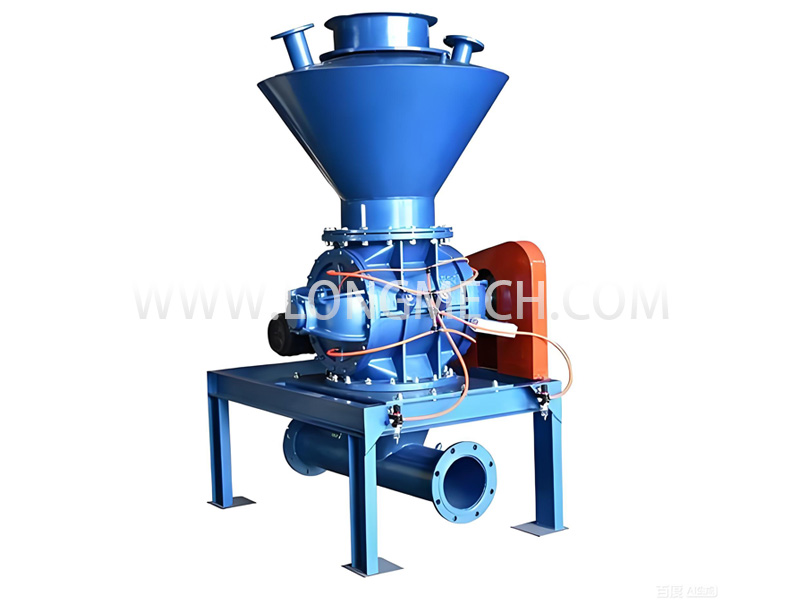
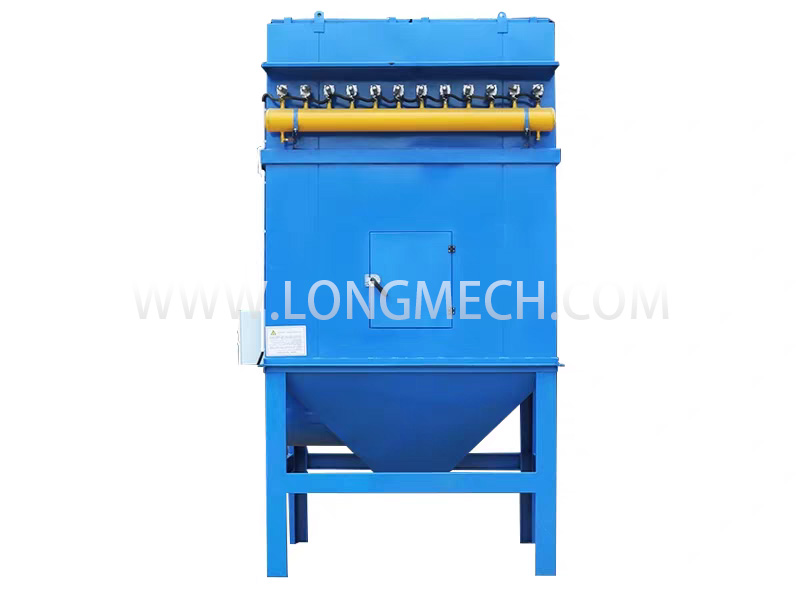
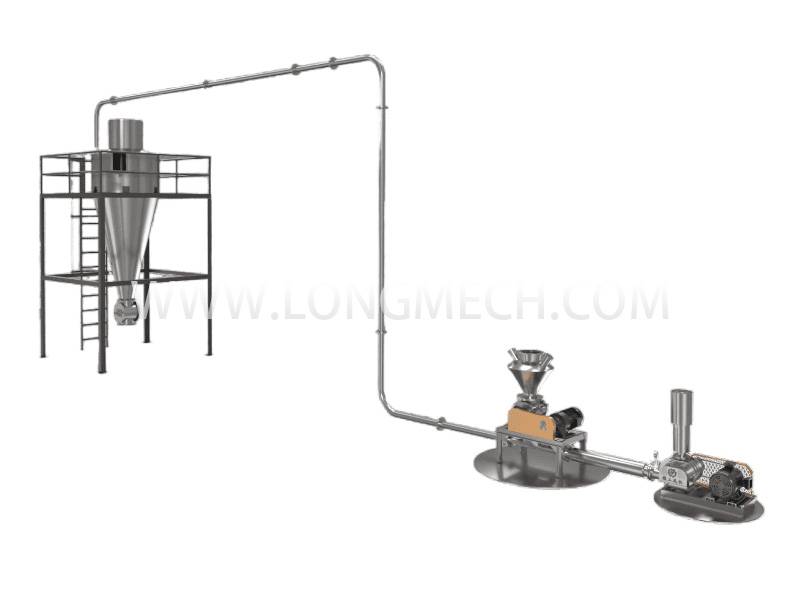
A pneumatic conveying system generally consists of core components: power source, feeding device, conveying pipeline, separation and dust removal device, and control system. Power sources include blowers, compressors or vacuum pumps; feeding devices include bin pumps, sending tanks, rotary valves; conveying pipelines include horizontal, vertical and bent pipes; separation and dust removal devices include cyclone separators and bag filters; control systems include PLC and DCS.
System Classification
Suction Type System
Operates under negative pressure, with a pressure range of -10 to -50 kPa. Suitable for short-distance scenarios with multiple feeding points. Typical configuration includes rotary valve feeders, wear-resistant elbows and multi-stage cyclone separators, achieving a material recovery rate of 99.2% in grain warehousing at flour mills.
Pressure Type System
Conveys via positive pressure airflow, with an operating pressure up to 700 kPa and conveying distance exceeding 2,000 meters. Dense-phase systems adopting double-pipe structure increase the solid-gas ratio to 40 kg/kg, with a single-system processing capacity of 120 tonnes per hour in coal chemical industry. Roots blowers are mostly selected as power equipment, and noise is reduced to below 85 dB after equipped with a soundproof chamber.
System Composition
Pneumatic conveying systems generally include air supply equipment, feeding devices, conveying pipelines, separation devices and control systems.
Air Supply Equipment
As the power source of the system, air supply equipment mainly includes blowers, compressors, vacuum pumps, etc., depending on the conveying mode (positive pressure / negative pressure).
Feeding Devices
Suction nozzles include fixed and movable types. Special suction nozzles for grain suction machines are equipped with secondary air supply structures, improving conveying efficiency by 23%. The clearance of rotary valves is controlled at 0.08–0.12 mm, and cast iron material withstands high-temperature working conditions up to 260 °C. Jet type utilizes the Venturi effect, with nozzle speed designed at 18–32 m/s, suitable for conveying highly abrasive alumina.
Conveying Pipeline Network
Straight pipes adopt seamless steel pipes with a wall thickness of 3–6 mm. The bending radius of elbows is designed differently according to system types: ≥ 1 meter for dilute-phase systems and ≥ 5 times pipe diameter for dense-phase systems. Utility pipelines undergo triple anti-corrosion treatment (sandblasting + epoxy primer + polyurethane topcoat), with a design service life of over 15 years.
Separation System
Design velocity of gravity separators is < 0.8 m/s. The diameter ratio of centrifugal separators to pipelines is 1:3.5. Filtration accuracy of bag filters reaches 5 μm. Ash silos are equipped with level monitoring and arch-breaking devices to ensure continuous discharge.
Control System
The control system realizes automatic control, operation monitoring and fault diagnosis, with core components such as PLC, DCS or intelligent control hosts, enabling intelligent parameter adjustment and energy-saving optimization.
Technical Characteristics
Applicable material particle size ranges from 0.1 to 50 mm, bulk density ≤ 2000 kg/m³, and moisture content controlled within 8%. System energy consumption is 0.3–0.6 kWh per tonne per 100 meters, saving 17–25% energy compared with mechanical conveying. After adopting intelligent control units, pressure fluctuation during conveying is controlled within ±5%, and failure rate drops to 0.7 times per 1,000 operating hours.
Pneumatic conveying systems have significant advantages: fully closed pipeline conveying ensures no dust leakage during normal operation, providing outstanding environmental performance; pipeline layout is flexible, allowing horizontal, vertical or inclined installation to adapt to complex spaces; high automation reduces labor costs and intensity. In addition, the system occupies a small area, is easy to maintain, and can perform simultaneous processes such as mixing, drying and cooling during conveying.
The system also has limitations: relatively high energy consumption under certain conditions, difficulty conveying highly viscous materials; risks of pipeline abrasion, blockage and particle breakage; and high design complexity requiring comprehensive consideration of multiple factors.
Selection of an appropriate system type shall comprehensively consider material properties, process requirements, environmental and safety standards, as well as investment and operation budgets.
Industrial Applications
New Energy Materials
In lithium battery cathode material production lines, it realizes dust-free conveying of lithium iron phosphate powder from mixing to sintering, with a breakage rate ≤ 0.3% and single-line capacity of 5 tonnes per hour. Polycrystalline silicon production adopts nitrogen-protected conveying systems, with oxygen content controlled < 10 ppm.
Food & Pharmaceuticals
In flour mill applications, 300-meter conveying pipelines maintain humidity at 85% ± 2%, reducing microbial growth by 92%. In the pharmaceutical industry, it meets USP standards, with a CV value of particle size distribution < 5% for capsule raw material conveying.
Engineering Machinery
After integrating pneumatic conveying modules, road sweepers achieve a suction particle size up to 80 mm, with operating dust concentration < 10 mg/m³, meeting China IV emission standards. In asphalt mixing plants, aggregate conveying efficiency is increased by 40% and fuel consumption reduced by 18%.
专业术语对照表
USP 标准:United States Pharmacopeia Standards
气力输送系统:Pneumatic Conveying System
稀相 / 浓相输送:Dilute-phase / Dense-phase Conveying
固气比(灰气比):Solid-gas Ratio
旋转阀:Rotary Valve
罗茨风机:Roots Blower
文丘里效应:Venturi Effect
破拱装置:Arch-breaking Device
磷酸铁锂:Lithium Iron Phosphate
多晶硅:Polycrystalline Silicon
CV 值(变异系数):Coefficient of Variation