Longmech in Aquaculture
Case 14.06.2022
In the era of rapid development of high‑density and intensive aquaculture, dissolved oxygen is the key indicator determining survival rate, growth rate and breeding efficiency. Roots blowers are widely recognized as the “artificial lung” of aquaculture water bodies due to their stable air pressure, high‑efficiency aeration, reliable long‑term operation, energy saving and low noise. They have become standard oxygen supply equipment for fish ponds, shrimp ponds, nurseries and industrial recirculating aquaculture systems (RAS). This article comprehensively analyzes how Roots blowers empower modern aquaculture from the perspectives of working principles, advantages, scenario applications, model selection and operation.
1. Working Principle of Roots Blowers in Aquaculture
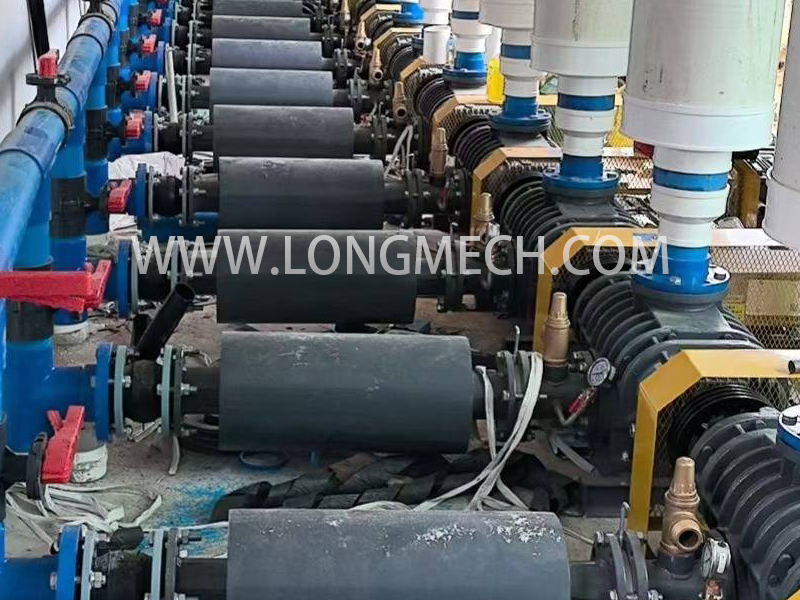
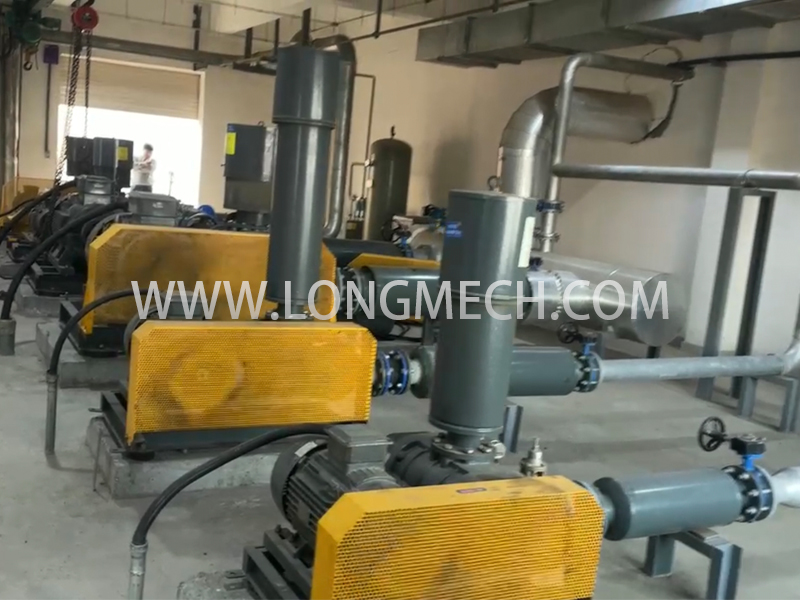
Roots blower is a positive displacement rotary blower that continuously compresses and delivers air through a pair of synchronized three‑lobed rotors meshing precisely inside the casing. In aquaculture systems, the blower sends air through main and branch pipes to the nanoscale aeration tubes / aeration discs at the pond bottom. The air rises slowly in the form of micro‑fine bubbles, prolonging gas‑liquid contact time and greatly improving oxygen dissolution efficiency. Meanwhile, the rising bubbles disturb the water body, promote the decomposition of benthic organic matter, and balance dissolved oxygen throughout the pond, fundamentally solving the problem of “oxygen‑rich upper layer, oxygen‑deficient bottom layer”.
2. Core Advantages of Roots Blowers vs. Traditional Aeration Methods
2.1 Uniform Oxygenation, No Bottom Hypoxia
Bottom microporous aeration covers the entire pond, providing stable oxygen supply even in deep‑water areas and corners. It effectively avoids layered hypoxia, floating, stress and mortality of fish and shrimp, especially suitable for ponds deeper than 2 meters and high‑density shrimp and crab farming.
2.2 Remarkable Energy Saving, Lower Long‑Term Electricity Cost
With high‑efficiency three‑lobed rotors and direct drive design, power consumption is 18%–30% lower than impeller or waterwheel aerators under the same oxygenation effect. For a 15kW unit running 24 hours a day, it can save about 400 yuan in electricity per month and nearly 5,000 yuan per year, directly improving breeding profits.
2.3 Stable Operation, 24‑Hour Continuous Service
The whole machine features simple structure and few wearing parts. With heavy‑duty bearings and reliable sealing, it can run continuously for a long time with low failure rate and minimal maintenance, suitable for unattended operation in large‑scale breeding bases.
2.4 Adaptable to Freshwater, Seawater, Humid and Saline‑Alkali Environments
Anti‑corrosion models are made of salt‑fog‑resistant and moisture‑proof materials, suitable for marine shrimp, sea cucumber, shellfish farming and industrial recirculating aquaculture systems with longer service life.
2.5 Improved Sediment and Water Quality, Reduced Diseases
Continuous aeration inhibits anaerobic fermentation, reduces harmful substances such as ammonia nitrogen, nitrite and hydrogen sulfide, lessens bottom odor, black sludge and disease outbreaks, and lowers medication costs.
3. Typical Application Scenarios in Aquaculture
3.1 Pond Culture (Fish, Shrimp, Crab, Yellow Catfish, Largemouth Bass, etc.)
The mainstream solution is Roots blower + bottom microporous aeration, combined with surface aerators to meet high oxygen demand during high‑density feeding periods, increasing stocking density and yield per mu.
3.2 Industrial Recirculating Aquaculture (Nursery & Grow‑Out)
High stability of dissolved oxygen and low noise are required, with DO maintained at 6–8 mg/L. Low‑noise variable‑frequency Roots blowers enable precise air volume and stable pressure, improving seedling survival rate and growth uniformity.
3.3 Marine & Tidal Flat Farming (Sea Cucumber, Shellfish, Penaeus Shrimp)
In high‑salt, high‑humidity and highly corrosive environments, anti‑corrosion Roots blowers maintain stable output without performance decay or rust, ensuring safety for deep‑water cages and cofferdam farming.
3.4 Holding Ponds & Transportation Oxygenation
Used for live fish holding and short‑distance transportation oxygen supply, with sufficient air pressure and quick startup to guarantee survival rate and quality of aquatic products.
4. Key Points for Selecting Roots Blowers in Aquaculture
- Air Volume: Calculated based on water volume, breeding density, water temperature and water exchange rate to ensure qualified dissolved oxygen.
- Pressure: Approximately 9.8 kPa per meter of water depth. High‑pressure models are preferred for deep ponds considering pipeline resistance.
- Power: Common models for conventional ponds range from 3kW to 37kW; variable‑frequency models are recommended for industrial and large‑scale bases for adjustable air supply and higher energy efficiency.
- Material & Protection: Anti‑corrosion coating + stainless steel fittings for seawater or saline‑alkali areas; rain cover for outdoor installation.
- Noise: Models with noise ≤75 dB are preferred in nurseries to avoid disturbing seedlings.
5. Daily Operation, Maintenance and Safety Tips
- Monitor oil temperature, vibration and noise during the running‑in period of new machines and replace lubricating oil in time.
- Clean the air filter regularly to prevent overload caused by insufficient air intake.
- Check pipeline leakage and clogging of aeration tubes to ensure uniform air distribution.
- Drain condensed water during long‑term shutdown to prevent rust and corrosion; strengthen anti‑corrosion maintenance in coastal areas.
- A one‑operational one‑standby configuration is recommended to avoid large‑scale hypoxia losses caused by single‑unit failure.
6. Conclusion
From traditional “natural oxygenation” to modern precise oxygen supply and stable yield increase, Roots blowers have become key equipment for cost reduction and efficiency improvement in aquaculture. With high‑efficiency aeration, stability, energy saving and wide adaptability, they help farmers increase density, improve survival rate, optimize water quality, and reduce disease and electricity expenses, serving as an ideal power core for both freshwater/marine and pond/industrial aquaculture.
Choosing a suitable Roots blower and scientific aeration system helps water bodies “breathe smoothly”, making aquaculture more stable, economical and profitable.