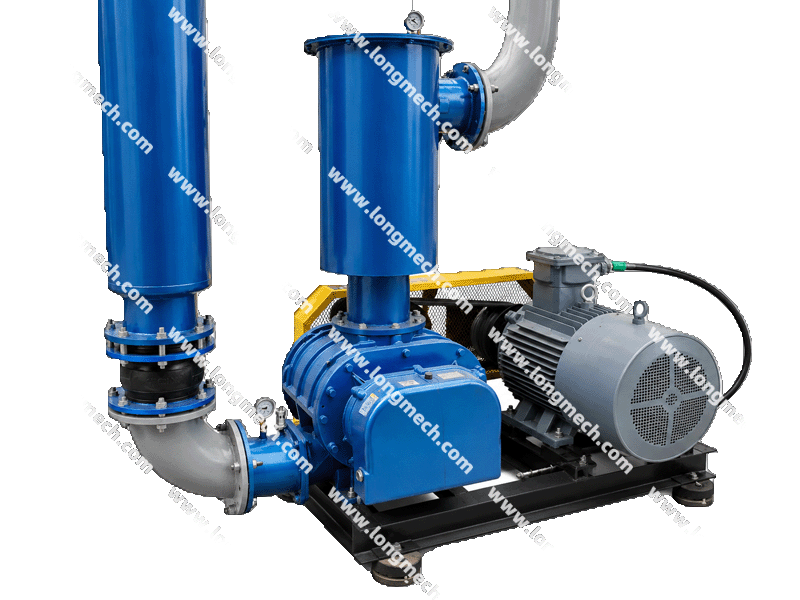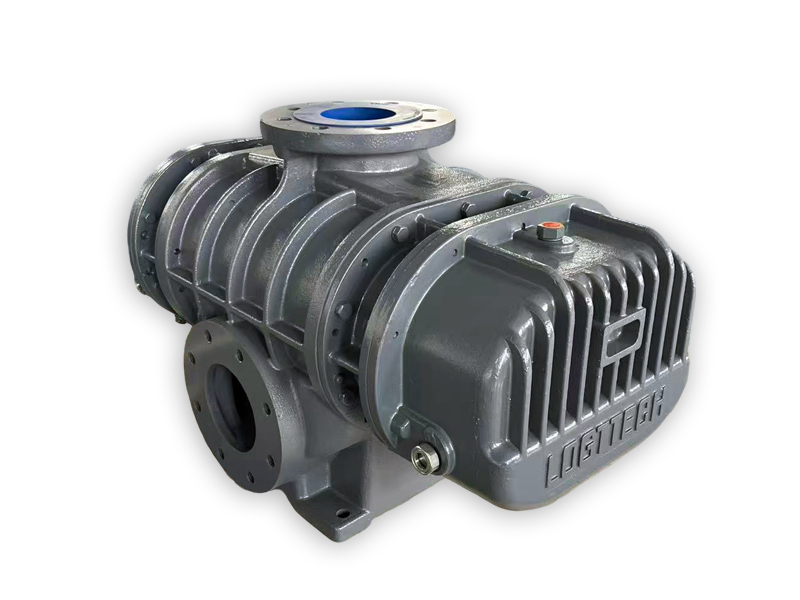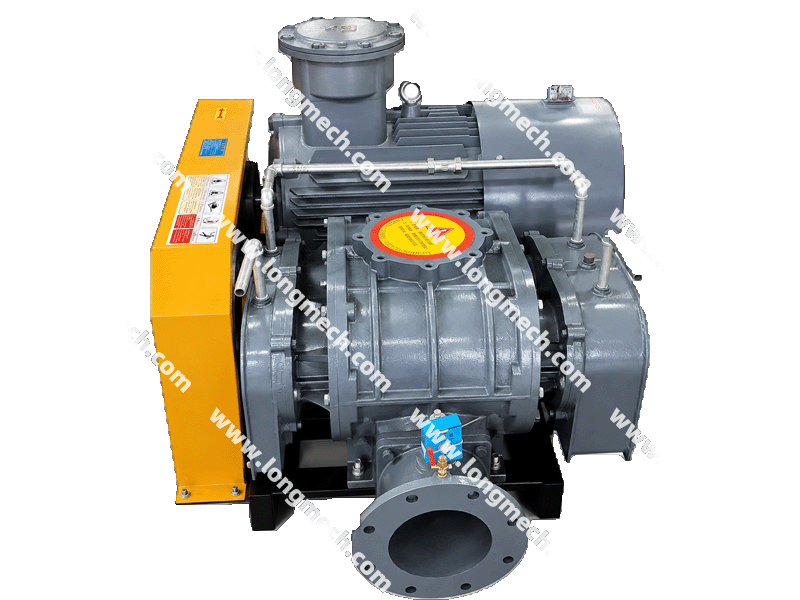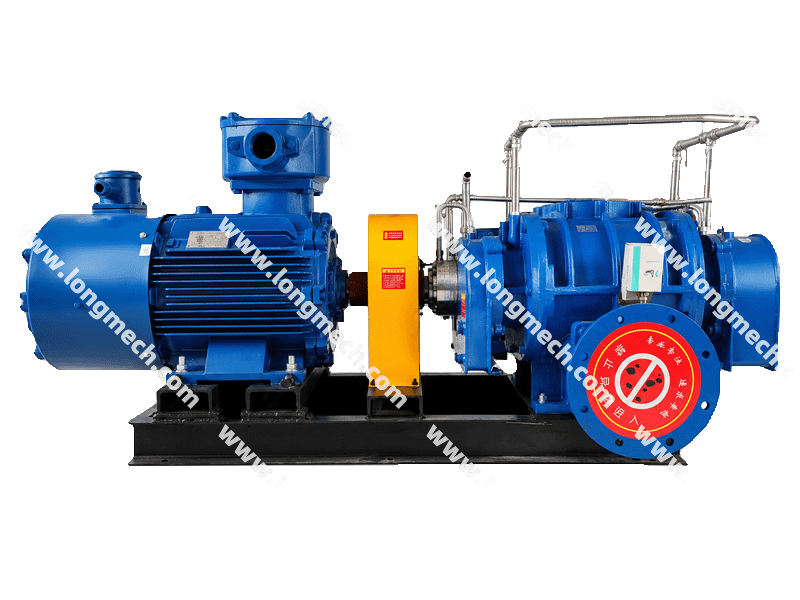
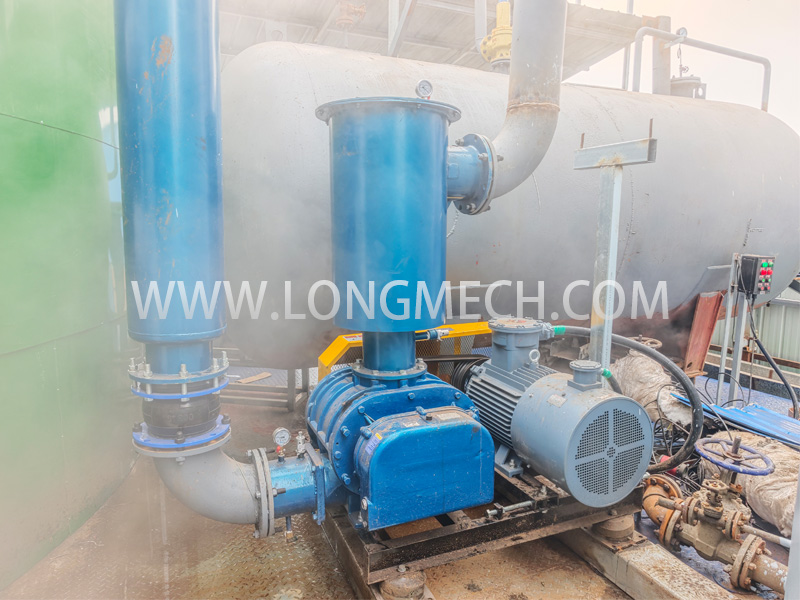
Positive and Negative Pressure Roots Blower System
Manufacturer: Longmech Machinery CO.,LTD
Place of Origin: China
Product Name: Intensive Roots blower
Product Model: SR50-400
Pressure: Postive pressure and Vacuum
Feature: Not leaked
specification: Contact us
Overall dimensions: Contact us
Applicable Industries: Pneumatic conveying, metallurgy, chemical industry, building materials, grain, food, medicine, paper making, printing, textile, environmental protection dust removal, garbage disposal, laboratory vacuum, tobacco, plastic, desulfurization and denitration, material adsorption, etc
Category:Roots blowers
Introduction
Common sealing forms for Roots blowers include gland packing type, sliding ring (expansion ring) type, labyrinth type, and mechanical seal, etc. The specific type to be used mainly depends on the properties of the gas—such as whether it is toxic, whether it can contact lubricating oil, whether it is flammable and explosive, clean, or valuable.
When delivering gases such as air, a pair of gland seals is usually arranged between each bearing and the cylinder, resulting in a total of four such seal sets, with one set of oil seals installed at the shaft extension end.
When delivering gases that must not come into contact with lubricating oil or grease, such as oxygen, nitrogen, and sulfur dioxide, four sets of mechanical seals are installed at the shaft penetration parts of the cylinder to completely isolate the lubricated parts of the bearings and gears from the gas, as shown in Figure 1a. This configuration increases the bearing span of the rotor.
When delivering coal gas or methane, a closed bearing housing is often adopted, with one set of gland packing seal at the shaft penetration parts. For gases such as hydrogen, mechanical seals can be used, as shown in Figure 1b.
When delivering acetylene, liquefied petroleum gas (LPG) and similar gases, four sets of mechanical seals are used, and the friction surfaces are cooled by the lubricating oil from the bearing and gear sections, as shown in Figure 1c.
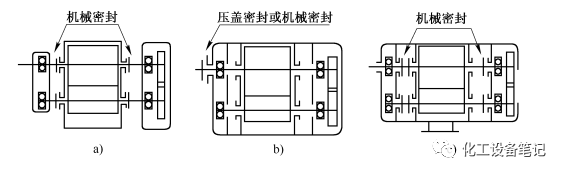
Figure 1 Mechanical Seals for (Gas) Roots Blowers
a) Open type
b), c) Closed type
Structural Features of Seals Used in Roots Blowers
Common shaft-end seals for Roots blowers fall into three types: gland type, framework type, and mechanical seal.
1. Gland Type
This is a simple and widely used sealing form, mostly applied for conveying air.
There are four gland‑type sealing locations connected to the cylinder. Several rings of asbestos oil packing are installed in the gland stuffing box. To reduce axial length, the seals are designed to be positioned close to the bearings.
During operation, the bolts around the gland can be tightened periodically to prevent gas leakage.
2. Framework Type
Framework‑type seals generally use framework rubber oil seals (see Figure 2).
Each seal assembly consists of two or three J‑shaped framework rubber oil seals: two are installed back‑to‑back on the inner side in contact with the conveyed medium, and one is mounted on the outer side. Grease can be injected into the space between them.
All sealing parts are assembled in a sealing sleeve to form an integrated component.
This structure provides good sealing performance and is suitable for high‑speed blowers.
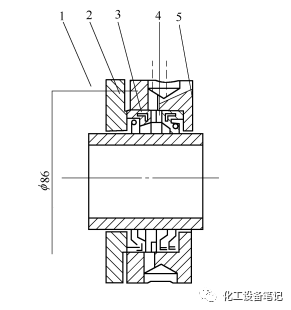
Figure 2 Oil Seal
1 – Countersunk screw
2 – Sealing gland
3 – Sliding framework rubber oil seal
4 – Sealing bushing
5 – Seal housing
3. Mechanical Seal
For blowers conveying special media (such as flammable, explosive, highly corrosive, toxic or harmful media), mechanical seals are adopted for the shaft-end sealing structure.
Mechanical seals feature reliable sealing performance, low leakage, long service life, low power loss and infrequent maintenance requirements. They can meet the sealing demands of automated production, as well as applications involving high temperature, low temperature, high pressure, high vacuum, high speed, and various flammable, explosive and corrosive media.
A mechanical seal is a sealing device formed by two sealing elements that fit closely against each other on their smooth, flat surfaces perpendicular to the axis and rotate relative to each other, as shown in Figure 3.
It usually consists of a stationary ring, a rotating ring, a spring loading device (including a push ring, springs, spring seat, set screws, drive pins, and auxiliary seals (rotating ring seal and stationary ring seal)), and other components.
An anti-rotation pin is fixed on the gland to prevent the stationary ring from rotating.
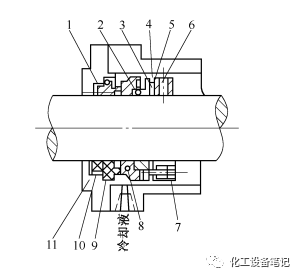
Figure 3 Mechanical Seal
1 – Stationary ring
2 – Rotating ring
3 – Spring loading device
4 – Spring
5 – Spring seat
6 – Set screw
7 – Drive pin
8 – Rotating ring seal
9 – Stationary ring seal
10 – Anti-rotation pin
11 – Gland
Materials used for friction pairs include non-metallic materials and metallic materials.
Commonly used non-metallic materials include pure graphite, impregnated graphite, polytetrafluoroethylene (PTFE), filled PTFE, phenolic plastic, ceramic, and sprayed ceramic.
Commonly used metallic materials include cast iron, carbon steel, bronze, chromium steel, chromium-nickel steel, cemented carbide, and so on.
Each material has specific properties. When selecting materials for the friction pair, reasonable selection shall be made according to actual operating conditions to ensure the working performance and service life of the friction pair.
Mechanical seals require high machining and assembly accuracy, resulting in high manufacturing costs. Therefore, they are rarely used in general blower sealing applications at present, and are only considered for a small number of cases involving toxic or harmful media.
gland packing type 填料压盖式 expansion ring /sliding ring type 胀圈式 labyrinth seal 迷宫式密封 mechanical seal 机械密封 shaft extension end 轴伸端 shaft penetration parts 轴贯通部分 closed bearing housing 闭式轴承箱 liquefied petroleum gas (LPG) 液化石油气 bearing span 轴承跨距
mechanical seal 机械密封 open type 开式 closed type 闭式 shaft-end seal 轴端密封 gland type 压盖式 framework type 骨架式 framework rubber oil seal 骨架橡胶油封 stuffing box 填料盒 asbestos oil packing 石棉油盘根 J-shaped framework rubber oil seal J 形骨架橡胶油封 back-to-back 背靠背安装 sealing sleeve 密封外套
countersunk screw 沉头螺钉 sealing gland 密封压盖 sliding framework rubber oil seal 滑架橡胶油封 sealing bushing 密封衬套 seal housing 密封外套 mechanical seal 机械密封 stationary ring 静环 rotating ring 动环 spring loading device 弹簧加荷装置 push ring 推环 spring seat 弹簧座 drive pin 传动销 auxiliary seal 辅助密封圈 anti-rotation pin 防转销
friction pair 摩擦副 pure graphite 纯石墨 impregnated graphite 浸渍石墨 polytetrafluoroethylene (PTFE) 聚四氟乙烯 filled PTFE 填充聚四氟乙烯 phenolic plastic 酚醛塑料 sprayed ceramic 喷涂陶瓷 chromium steel 铬钢 chromium-nickel steel 铬镍钢 cemented carbide 硬质合金 machining accuracy 加工精度 assembly accuracy 装配精度